

Paediatric dry eye has no single resolution time: the course depends on the underlying cause, ocular surface findings and response to treatment. Symptom relief does not establish that the condition has resolved, and persistent lid disease or other contributing factors can require ongoing management. Pain, photophobia or reduced vision require urgent assessment rather than waiting for dry eye treatment to work.
- Paediatric dry eye resolve time depends on the cause; symptom relief and sustained ocular surface recovery are different endpoints.
- Assess symptoms, corneal findings, lid disease and treatment use together before changing a child’s management plan.
- Pain, photophobia or reduced vision require urgent assessment, not an extended trial of lubricants.
- Scope Connect supports eye care professionals with dry eye disease education and patient education materials.
How long does paediatric dry eye take to resolve?
There is no fixed interval that applies to every child with dry eye. A useful prognosis starts with identifying what is driving the symptoms and deciding what improvement should look like. A child who feels more comfortable after lubrication has reached a different endpoint from a child whose corneal staining and lid findings have improved.
For clinical discussions in 2026, distinguish these outcomes rather than offering a universal recovery deadline:
| Outcome | What you are assessing | What it does not establish |
|---|---|---|
| Symptom relief | Less discomfort, grittiness or fluctuating blur | That the underlying cause has resolved |
| Ocular surface improvement | Improvement in relevant examination findings | That management can stop immediately |
| Sustained control | Comfort and stable findings under the agreed plan | That future episodes cannot occur |
Explain which endpoint you are working towards. This makes review appointments more useful and avoids interpreting temporary comfort as complete recovery.
Why this matters
Families often want a finish date because treatment has to fit around school, activities and caregiver support. An unsupported deadline creates the wrong expectation: continuing symptoms become a perceived treatment failure, while early relief becomes a reason to stop.
Scope Connect provides clinical resources and patient education materials for eye care professionals. Use clear explanations alongside your clinical assessment so that families understand both the treatment plan and the reasons to return earlier.
The practical question is not simply whether the child's eyes feel better. It is whether symptoms, examination findings and daily function are improving together.
What counts as resolution in a child?
A child does not need to describe classic adult dry eye symptoms for ocular surface discomfort to deserve assessment. Ask about rubbing, blinking, difficulty with sustained visual tasks and changes in comfort across the day, while recognising that these observations are not diagnostic by themselves.
Establish a baseline that you can revisit. Record the child's account in their own words, the caregiver's observations and the relevant clinical findings; do not let any single component stand in for the whole assessment.
Symptom improvement
Ask whether the child can complete the activities that previously provoked discomfort. A specific comparison, such as reading comfortably rather than stopping to rub the eyes, is more useful than a general report that things are better.
Symptom improvement is valuable, but it does not replace examination. Discomfort and observable ocular surface signs do not always move together.
Clinical improvement
Review the findings that supported the original working diagnosis. Depending on the presentation, these include corneal staining, tear film behaviour, lid margins and meibomian gland function.
Use a consistent examination approach so that differences between visits are interpretable. An isolated measurement should not determine that a child has recovered or that a treatment has failed.
Sustained control
Before reducing treatment, consider whether the relevant contributors remain active and whether the family understands the revised plan. Changes should follow reassessment, not an assumed expiry date for dry eye.
For your 2026 patient information, define recovery as an individual clinical judgement rather than a countdown. State what the family should observe and what you need to confirm at review.
Why paediatric dry eye recovery varies
The diagnosis and continuing contributors matter more than a generic recovery estimate. Assess these factors before explaining the likely course:
- Underlying cause: evaporative dysfunction, ocular surface exposure and other contributors require different management decisions. Similar symptoms do not establish the same diagnosis.
- Lid disease: blepharitis and meibomian gland dysfunction need attention when present; lubrication alone does not address every lid-related contributor.
- Coexisting allergy: itching and rubbing warrant assessment for allergic disease rather than automatically increasing dry eye treatment.
- Visual tasks and environment: sustained near work, incomplete blinking and direct airflow are relevant history points. Assess their relationship to symptoms rather than assuming that screens explain the presentation.
- Treatment delivery: discomfort during instillation, uncertain technique and competing family routines affect whether the prescribed plan is actually being followed.
- Clinical severity and other conditions: corneal involvement, contact lens wear and relevant medical history change assessment, follow-up and referral decisions.
Ask which of these factors is active in the individual child. A long list of possible causes is not a substitute for a documented working diagnosis.
How should you assess progress before changing treatment?
Use a repeatable review process rather than extending the same plan simply because symptoms continue. The purpose is to establish whether the diagnosis remains appropriate, whether treatment is reaching the eye as intended and whether the ocular surface is improving.
- Check safety. Ask about pain, light sensitivity and visual change before discussing routine progress. Concerning symptoms take priority over the original dry eye label.
- Revisit symptoms. Compare the child's current experience with the baseline. Include schoolwork, reading and other activities relevant to that child.
- Review delivery. Ask the caregiver to describe or demonstrate the agreed routine. Check the actual product, administration and any difficulties without treating adherence as a blame issue.
- Reassess findings. Repeat the relevant ocular surface and lid examination. Investigate a mismatch between reported comfort and clinical findings rather than dismissing either.
- Agree next steps. Document whether you are continuing, adjusting or escalating management, and explain what should trigger earlier contact.
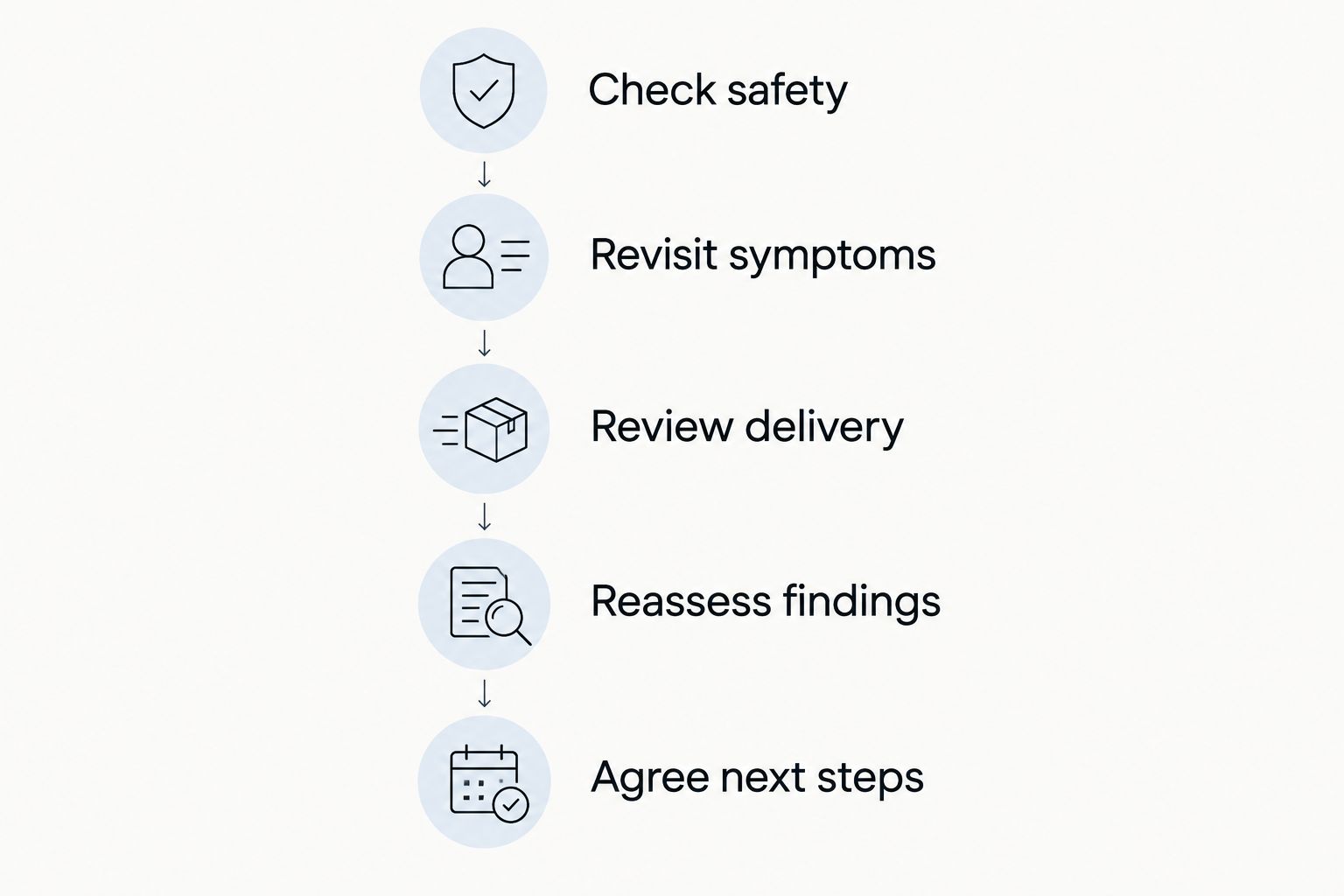
Make your 2026 review template record the treatment goal as well as the treatment itself. Without that goal, a follow-up can document continued symptoms without clarifying whether the current plan is helping.
Which management approaches address different contributors?
There is no single intervention that establishes a predictable resolution time for every child. Match management to the findings, check age suitability and instructions, and stay within your professional scope.
The approaches below are not interchangeable. Each addresses a different part of the clinical picture, and some children need more than one approach.
| Approach | Best for | Useful role | Limitation or caution |
|---|---|---|---|
| Ocular lubricants | Children whose assessment supports lubrication | Support ocular comfort and lubrication | Do not establish or remove the underlying cause; check age suitability |
| Clinician-directed lid care | Children with relevant lid margin disease | Addresses an identified lid-related contributor | Technique, tolerance and caregiver supervision matter |
| Task and environment changes | Children with reproducible task-related symptoms | Reduces relevant exposure and supports comfortable visual habits | Does not replace examination or treatment of ocular disease |
| Condition-specific treatment or referral | Children with allergy, inflammation or findings outside routine management | Directs care towards the identified condition | Requires an appropriate diagnosis and prescribing or referral pathway |
For formulation considerations, see the guide to preservative-free eye drops for paediatric dry eye. A preservative-free formulation does not, by itself, establish suitability for every child or a faster recovery time.
Avoid transferring adult treatment protocols directly into paediatric care. Check the individual product information and relevant clinical guidance, particularly before recommending medicines or heated devices.
What should you tell parents about the expected course?
Give families an explanation they can act on: treatment aims to improve comfort and ocular surface health, while review establishes whether the plan is working. Some children need continuing management because the contributing condition persists.
For a 2026 written care plan, include the agreed treatment, who will administer it, the review arrangements and the symptoms that require earlier assessment. Keep the instructions consistent with what you demonstrated in the consultation.
Useful questions to answer explicitly include:
- What finding or symptom is the treatment intended to improve?
- How should the family use the recommended treatment?
- What should they do if administration is difficult or uncomfortable?
- Which changes should prompt contact before the planned review?
Ask the caregiver to explain the plan back in their own words. This checks whether the instructions are workable, rather than merely whether they have been heard.
Does feeling better mean the dry eye has resolved?
Feeling better does not establish that paediatric dry eye has resolved. Lubrication can improve comfort while lid disease, exposure or other contributors remain.
Review relevant clinical findings before advising a change in management. Explain any reduction or continuation clearly so that families do not have to infer the next step from symptoms alone.
Why are symptoms continuing despite eye drops?
Persistent symptoms require reassessment of the diagnosis, treatment delivery and contributing conditions. They do not automatically mean that the child needs a different lubricant or a more intensive routine.
Check for allergy, lid disease, exposure, contact lens-related problems and other explanations supported by the history and examination. If the findings do not fit straightforward dry eye, revise the working diagnosis or arrange appropriate referral.
When should a child receive urgent assessment?
Pain, photophobia or reduced vision require urgent eye assessment. Significant redness, corneal abnormalities or a painful red eye in a contact lens wearer also require prompt attention through the appropriate local pathway.
Do not advise a family to complete a routine dry eye trial before seeking help for these symptoms. A previous dry eye diagnosis does not exclude a new or different eye condition.
FAQ
What is the usual paediatric dry eye resolve time?
There is no single paediatric dry eye resolve time that applies to every child. The course depends on the cause, examination findings, treatment delivery and whether contributing conditions remain active.
Can a child’s dry eye go away permanently?
Paediatric dry eye symptoms can settle, but permanent resolution cannot be promised. Continuing lid disease, exposure or other contributors can require ongoing management and reassessment.
Should I stop my child’s drops when their eyes feel better?
Follow the clinician’s treatment plan rather than stopping solely because symptoms improve. Improved comfort does not establish that ocular surface findings or the underlying contributor have resolved.
Why does my child still have dry eyes after using drops?
Persistent symptoms need reassessment of the diagnosis, treatment delivery and contributing conditions. Lubricants do not address every cause of ocular discomfort, including coexisting allergy or lid disease.
Do screen breaks cure dry eye in children?
Screen breaks do not establish a cure for paediatric dry eye. Task changes and attention to blinking can form part of management when the history supports a relationship, but they do not replace an eye examination.
Are preservative-free eye drops suitable for every child?
Preservative-free eye drops are not automatically suitable for every child. Check the individual formulation, age-related instructions and clinician’s recommendation rather than selecting on preservative status alone.
When should I seek urgent help for my child’s dry eye symptoms?
Seek urgent eye assessment for pain, light sensitivity or reduced vision. Do not wait for a routine review or assume that an existing dry eye diagnosis explains new symptoms.
One last thing
Record what improvement means before treatment starts. A brief baseline covering comfort, a relevant daily activity and the examination findings gives the next clinician something useful to compare.
Scope Connect is an eye care education resource for clinicians, not a substitute for examining the child. Use Scope Connect's dry eye disease materials to support your 2026 clinical conversations while keeping prognosis and treatment decisions specific to the patient.
Related guides
- Ocular surface optimisation for trainee optometrists
- Oxford grading scale and dry eye severity staging
- How quickly can microbial keratitis cause vision loss?