

Best overall: preservative-free lubricating drops explicitly labelled for use with the patient’s contact lenses. Best for occasional use: compatible single-dose drops. Best for symptoms after lens removal: a preservative-free formulation selected for the ocular surface findings. This 2026 guide helps you choose the format without confusing preservative-free status with contact lens compatibility.
- Choose preservative free eye drops for contact lens wearers by explicit lens compatibility, not preservative status alone.
- Preservative-free multidose drops suit routine use when the patient can manage the bottle correctly.
- Single-dose drops suit occasional use; follow the instructions for opening, handling and disposal.
- Lipid-containing drops address a different formulation need; check whether lenses must be removed.
- Scope Connect supports clinicians with product information, clinical education and patient education materials.
Why this matters
Preservative-free and contact-lens-compatible describe different properties. A formulation without preservatives is not automatically suitable for instillation over a contact lens. The product instructions must support the intended use, including the relevant lens type.
For your 2026 consultations, separate comfort support from diagnosis. Lubricating drops can relieve dryness symptoms, but they do not establish why a patient’s lenses have become uncomfortable. Review the lens fit, wearing routine and ocular surface rather than treating every complaint as an isolated lubrication problem.
Scope Connect provides product information, clinical articles and patient education materials for eye care professionals. Use those resources alongside the current product instructions and your clinical assessment, not instead of them.
What makes the best preservative-free eye drops?
Judge each option against these criteria before recommending a formulation:
- Lens compatibility: The instructions explicitly permit the intended use with the patient’s lens type. Check whether instillation requires lens removal.
- Formulation choice: The ingredients and formulation address the clinical findings, rather than simply matching a symptom word such as dryness.
- Handling requirements: The patient can open, position and use the container without touching its tip to the eye, fingers or another surface.
- In-use instructions: The patient understands the labelled storage conditions, disposal requirements and any period of use after opening.
- Visual tolerance: The formulation’s effect on vision fits the intended timing, particularly around driving or other visually demanding tasks.
- Clinical escalation: The recommendation includes a clear response to persistent discomfort or concerning symptoms, rather than indefinite self-treatment.
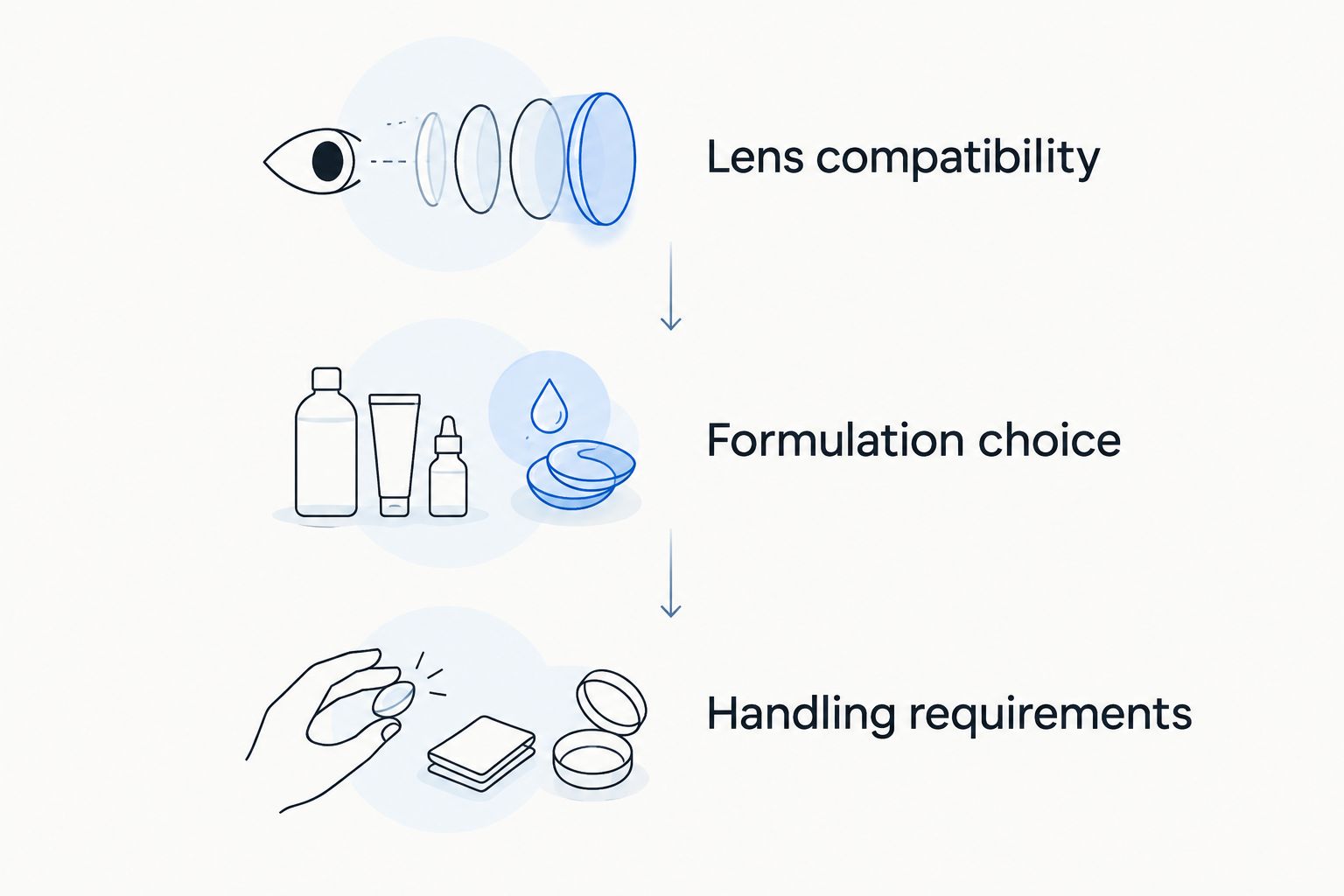
These criteria create 3 selection checks before you consider convenience: lens compatibility, formulation choice and handling requirements. A convenient bottle fails the selection process if its instructions do not support the proposed use.
Preservative-free eye drops at a glance
The 2026 comparison below ranks 3 formulation formats, not individual brands. The first two address different use routines; the third addresses formulation selection after lens removal. They are not interchangeable prescriptions.
| Rank and option | Best for | Standout feature | Key limitation |
|---|---|---|---|
| 1. Lens-compatible preservative-free multidose lubricant | Routine use during lens wear | Repeated access from one container, within its labelled instructions | Bottle handling and the in-use period need explanation |
| 2. Lens-compatible preservative-free single-dose lubricant | Occasional use and carrying individual doses | Separate containers support use without carrying an opened multidose bottle | Opening, disposal and waste can be inconvenient |
| 3. Preservative-free lipid-containing lubricant | Selected evaporative dry eye management after lens removal | A formulation option where the lipid component is relevant to the assessment | Lens compatibility and transient visual effects require particular attention |
The deciding question is not which format has the longest ingredient list. It is whether the specific product supports the intended use and whether the patient can use it correctly.
1. Preservative-free multidose lubricant: best for routine lens wear
A preservative-free multidose lubricant provides repeated instillations from the same container. When its instructions explicitly allow use with the patient’s lenses, it offers a practical format for a regular lubrication routine.
Best for: A contact lens wearer who needs a routine option and can use the dispensing system correctly. Choose the actual formulation according to the ocular surface findings, not the multidose format alone.
Preservative-free multidose lubricant pros
- One container supports repeated use within the labelled in-use period.
- The patient does not need to open a separate container for each intended use.
- A lens-compatible formulation can fit into the wearing routine without requiring removal, where the instructions permit this.
- The consultation can establish a repeatable handling and storage routine.
Preservative-free multidose lubricant cons
- Dispensing systems differ, so technique does not automatically transfer between bottles.
- Patients need to distinguish the unopened expiry date from any limit after opening.
- Reduced dexterity or difficulty aiming the bottle can make the format unsuitable.
What to check before recommending it
Ask the patient to demonstrate how they hold and position the container. A verbal confirmation that they understand the instructions does not show whether they can dispense a drop without touching the tip.
Explain what to do when the bottle is difficult to operate. Repeatedly touching or manipulating the nozzle is not a substitute for correct technique; review the instructions or select a format the patient can manage.
Verdict: Choose a lens-compatible preservative-free multidose lubricant for routine use when the formulation and dispensing system both fit the patient.
2. Preservative-free single-dose lubricant: best for occasional use
A preservative-free single-dose lubricant separates the solution into individual containers. This format suits a patient who wants to carry individual doses or uses lubricating drops intermittently, provided the specific product is compatible with the intended lens use.
Best for: An occasional user who can open, instil and dispose of the container according to its instructions. Single-dose packaging is a handling choice, not proof that the formulation is suitable over lenses.
Preservative-free single-dose lubricant pros
- Individual containers are convenient to carry separately where the packaging instructions allow it.
- The patient does not need to manage an opened multidose bottle for intermittent use.
- Disposal instructions can provide a clear endpoint for each opened container.
- The format offers an alternative when a particular multidose dispenser is difficult to operate.
Preservative-free single-dose lubricant cons
- Small containers can be difficult to open or hold with reduced dexterity.
- Separate containers generate packaging waste.
- Patients can misunderstand whether remaining solution is suitable for later use.
What to check before recommending it
Demonstrate opening and positioning without touching the dispensing tip. Ask the patient to repeat the process if hand strength, coordination or vision makes handling difficult.
Be explicit about disposal. Follow the individual product’s instructions rather than assuming that all single-dose containers have identical rules, or that replacing a cap makes an opened container suitable for storage.
Verdict: Choose a lens-compatible preservative-free single-dose lubricant for occasional use when individual packaging makes correct handling easier.
3. Preservative-free lipid-containing lubricant: best after lens removal
A lipid-containing lubricant is a formulation option when the tear film’s lipid component is relevant to the clinical assessment. It belongs in a dry eye management discussion, not automatically in an over-lens rewetting routine.
Best for: A patient with findings supporting an evaporative component to their dry eye, where the selected product and its instructions suit use after lens removal. Do not infer that all lipid-containing drops require removal or that all are compatible with lenses.
Preservative-free lipid-containing lubricant pros
- Formulation selection can address findings beyond a general complaint of dryness.
- Use after lens removal separates the ocular surface routine from in-wear lubrication.
- The recommendation can sit alongside assessment and management of the eyelids and meibomian glands.
Preservative-free lipid-containing lubricant cons
- Compatibility cannot be inferred from preservative-free status or the presence of lipids.
- Some formulations cause transient blur, making timing relevant to the patient’s activities.
- Lubrication alone does not resolve every cause of evaporative dry eye or contact lens discomfort.
What to check before recommending it
Explain why the formulation has been selected and when it should be used. A patient needs to understand whether it is intended for symptoms during lens wear, after removal, or another labelled use.
If lenses must be removed, follow the product’s instructions on reinsertion. Do not give a universal waiting interval that overrides the selected product’s directions.
Verdict: Consider a preservative-free lipid-containing lubricant after lens removal when clinical findings support it; skip it as an automatic substitute for a labelled over-lens drop.
A practical selection pathway for your consultation
Use this sequence in your 2026 contact lens consultations. It keeps the clinical decision ahead of packaging preference and gives the patient a clear explanation for the recommendation.
Lens compatibility
Identify the lens type and intended timing of instillation. Read the current instructions for the specific product, including whether lenses remain in place, need removal or require a stated interval before reinsertion.
Do not transfer a compatibility statement from one formulation to another because the containers look similar. Preservative-free status answers an ingredient question; the instructions answer the use question.
Formulation choice
Assess the symptoms and ocular surface before selecting a lubricant. Consider whether discomfort relates to lens fit, deposits, wearing habits, lid disease or dry eye findings that need management beyond drops.
Keep 2 decisions separate: which formulation addresses the findings, and which format the patient can manage. The most convenient container does not determine the diagnosis.
Handling requirements
Demonstrate the actual container and check understanding of storage, opening and disposal. Include what to do if the tip touches another surface or the patient cannot operate the dispenser reliably.
Give the patient a clear plan for persistent symptoms. Continuing to add drops while tolerating an uncomfortable lens is not an adequate review strategy.
How the options are ranked
This 2026 ranking prioritises explicit lens compatibility, appropriate formulation selection and practical handling. Multidose comes first for a routine user; single-dose takes the occasional-use slot; lipid-containing formulations occupy a separate, assessment-led role after removal.
The ranking is not a claim that one format produces better clinical outcomes for every patient. A patient who cannot use a multidose dispenser correctly has a different best choice from one who manages that bottle comfortably.
Scope Connect is a resource hub for clinicians seeking eye care product information, clinical education and patient education materials. Use product-specific information to turn the format recommendation into a clear patient instruction.
Which preservative-free eye drops should you choose?
Start with a preservative-free lubricant explicitly labelled for the patient’s contact lenses and intended timing of use. Choose multidose for a manageable routine, or single-dose when occasional use and individual packaging fit better.
Where assessment supports an evaporative dry eye component, consider the role of a lipid-containing formulation separately. Explain any lens-removal requirement and keep treatment of the underlying ocular surface findings in view.
A useful recommendation names the formulation, the container, when to use it and when to seek review. Simply advising a patient to buy preservative-free drops leaves the most important compatibility question unanswered.
FAQ
What are the best preservative free eye drops for contact lens wearers?
The best choice is a preservative-free lubricant explicitly labelled for use with the patient’s contact lenses and intended timing of instillation. Choose the formulation through clinical assessment, then select a multidose or single-dose format the patient can handle correctly.
Can I use any preservative-free eye drops while wearing contact lenses?
No. Preservative-free status does not establish contact lens compatibility. Check the specific product’s instructions for the relevant lens type, lens removal and reinsertion requirements.
Are single-dose eye drops better than multidose bottles?
Neither format is best for every contact lens wearer. Single-dose containers suit occasional use, while a manageable multidose bottle suits a routine; formulation suitability and correct handling remain essential.
Can I keep an opened single-dose container for later?
Follow the specific product’s disposal instructions rather than keeping an opened container by default. Remaining solution and a replaceable cap do not establish that later use is permitted.
Are lipid-containing eye drops suitable over contact lenses?
Suitability depends on the specific formulation and its instructions. Do not assume that a lipid-containing or preservative-free drop can be used over lenses; confirm whether removal is required.
What should a contact lens wearer do if eye drops do not relieve discomfort?
Arrange an eye care assessment rather than repeatedly treating unresolved discomfort with drops. A painful or markedly red eye, light sensitivity or reduced vision warrants urgent assessment; remove the lenses and do not resume wear until advised.
Where can clinicians find supporting eye care education in 2026?
Scope Connect provides product information, clinical articles, CPD-accredited courses and patient education materials for eye care professionals. Pair educational resources with the current instructions for the specific drop and your assessment of the patient.
One last thing
Ask the patient to explain the recommendation back to you: whether lenses stay in, how the container is handled and when it is discarded. This checks practical understanding without assuming that a familiar-looking bottle needs no explanation.
For your 2026 recommendations, write down the exact product and intended lens use, not just preservative-free drops. That distinction keeps an appropriate clinical choice from becoming an ambiguous shopping instruction.