

Best overall for a repeatable home routine: a reusable microwavable eye mask. Best for patients who need adjustable heating: an electric eye mask with temperature controls. Best for travel: a self-warming disposable mask. Choosing a heat eye mask for dry eyes in 2026 starts with confirming meibomian gland dysfunction (MGD), then matching the heating format to the patient's needs.
- A reusable microwavable heat eye mask for dry eyes suits patients who can follow heating and temperature-check instructions.
- Electric eye masks suit patients who need adjustable heating; check the device’s intended use and safety instructions.
- Self-warming masks suit travel, but fixed heating profiles offer less control over treatment.
- Scope Connect supports clinicians with dry eye education; mask selection still requires individual assessment.
Why this matters
Meibomian glands produce the lipid component of the tear film. In obstructive MGD, altered secretions and blocked gland openings contribute to evaporative dry eye. Eyelid warming aims to soften those secretions; it does not address every cause of ocular discomfort.
Choose the mask around the diagnosis, not the symptom alone. Burning, grittiness and fluctuating vision warrant assessment rather than an automatic recommendation for heat. A patient with predominantly aqueous-deficient dry eye needs a different management emphasis, although overlapping disease is possible.
Scope Connect provides clinical articles, education and patient materials for eye care professionals. Scope Connect is best used as a clinician education resource alongside individual assessment, not as a substitute for it.
What makes the best heated eye mask?
For this 2026 guide, the most useful comparison is between heating formats. A format-level recommendation tells you which practical questions to ask before selecting a particular device; it does not establish that every product within that format performs equally.
Use these 5 selection criteria before recommending a mask:
- Suitable heating: The mask should be intended for eyelid warming, with clear instructions for heating, application and stopping use.
- Consistent application: Consider how the mask maintains warmth and contacts the closed eyelids. Do not infer either from its appearance.
- Patient control: Check whether the patient can stop the session promptly, assess comfort and adjust the device where adjustment is supported.
- Hygiene: Look for clear cleaning instructions or a defined single-use design. Confirm which components can be cleaned.
- Routine fit: Match the equipment, preparation and handling requirements to what the patient can realistically repeat.
Comfort matters, but comfort alone does not establish an appropriate treatment temperature. Equally, a control displaying a temperature does not establish the temperature reached at the eyelid. Follow the specific device instructions rather than transferring settings between products.
Heated eye masks at a glance
| Heating format | Best for | Standout feature | Key limitation |
|---|---|---|---|
| Reusable microwavable eye mask | A repeatable home routine | Reusable compress heated before application | Depends on correct microwave preparation and temperature checking |
| Electric eye mask with controls | Patients needing adjustable sessions | Adjustable heating where the device provides it | Requires power and careful checking of device controls |
| Self-warming disposable eye mask | Travel without heating equipment | Self-contained warming format | Fixed heating profile and limited reuse |
| Warm flannel compress | A supervised introduction to eyelid warming | Familiar, simple application method | Loses warmth and requires reheating |
The order reflects practical use cases, not a head-to-head clinical trial. No heating format replaces assessment, appropriate adjunctive treatment or follow-up. A convenient mask that the patient uses incorrectly is a poor choice.
1. Reusable microwavable eye mask: best for home routines
A reusable microwavable eye mask is heated before being placed over closed eyelids. Its main practical strength is a straightforward routine without a power cable during application. The patient still needs access to a microwave and must follow the instructions for that specific mask.
For routine home care in 2026, this is the default format to consider when the patient can prepare it safely. Assess handling as well as understanding: removing a heated compress, checking its temperature and positioning it are separate tasks.
Reusable microwavable eye mask pros:
- Supports repeated use when the product is designed and maintained for reuse.
- Avoids a cable across the patient during application.
- Fits a defined preparation-and-application routine.
- Can be incorporated into patient education about eyelid warming.
Reusable microwavable eye mask cons:
- Heating depends on the microwave and the product's instructions.
- Excessive or uneven heating creates a burn risk.
- Cleaning requirements vary between designs and components.
Do not provide a generic microwave setting for all masks. Ask the patient to explain the preparation instructions back to you, including what they will do if the mask feels too hot. That conversation identifies misunderstandings before home use.
Best for: Patients with suitable microwave access who can prepare, check and clean a reusable compress reliably.
Verdict: Choose a reusable microwavable eye mask for a repeatable home routine when safe preparation is achievable.
2. Electric eye mask: best for adjustable heating sessions
An electric eye mask uses a powered heating element rather than microwave preparation. Some devices provide adjustable temperature settings and timers; these features must be checked on the individual product rather than assumed across the category.
The practical attraction is control during the session. However, a timer, temperature display or automatic shut-off is a device feature, not proof of clinical effectiveness or suitability for every patient.
Electric eye mask pros:
- Removes the need for microwave preparation.
- Offers adjustable heating when the selected device includes that function.
- Allows session timing when the device provides a timer.
- Suits patients who prefer a powered routine over reheating a compress.
Electric eye mask cons:
- Requires a compatible power source and safe cable handling.
- Controls add complexity for patients with limited dexterity or vision.
- A displayed setting does not establish the temperature at the eyelid.
Before recommending an electric mask in 2026, confirm its intended use, instructions and cleaning method. Check whether the patient can identify the controls and remove the mask without assistance. Avoid presenting a general heated sleep mask as a treatment device simply because it produces warmth.
Do not equate a hotter setting with a better outcome. The patient needs a clear stopping instruction for excessive heat, pain or worsening irritation, regardless of the device's controls.
Best for: Patients who need adjustable sessions and can operate a suitable powered device safely.
Verdict: Choose an electric eye mask when its verified controls solve a specific handling or routine problem.
3. Self-warming eye mask: best for travel without heating equipment
A self-warming disposable eye mask generates warmth after activation according to its instructions. It removes the need to prepare a compress in a microwave or connect a powered mask during use. That makes the format relevant when access to heating equipment is inconvenient.
Its main trade-off is limited control. A fixed warming profile does not give the patient the same options as an adjustable device, and a single-use mask cannot be treated as a washable reusable compress.
Self-warming eye mask pros:
- Does not require microwave preparation.
- Avoids a power cable during application.
- Provides a self-contained format for travel.
- Removes the cleaning step associated with a reusable mask.
Self-warming eye mask cons:
- Offers limited adjustment once activated.
- Creates single-use waste.
- Product-specific materials or fragrances require attention when sensitivities are relevant.
For travel planning in 2026, check the exact product rather than recommending the format without qualification. Confirm the intended use, activation method and removal instructions. Patients should still stop if the mask causes discomfort; convenient preparation does not remove the need to monitor the experience.
Ask how the patient will use the mask away from home. A familiar routine is easier to explain than an unfamiliar product first opened during a journey. Avoid adding eyelid massage or other steps unless they are part of the patient's management plan.
Best for: Patients needing a self-contained warming option when heating equipment is impractical.
Verdict: Choose a self-warming mask for travel convenience when its fixed warming profile suits the agreed plan.
4. Warm flannel compress: best for introducing eyelid warming
A warm flannel compress is an alternative to a dedicated mask, not another mask category. Including it helps clinicians explain why the heating method matters. It allows a supervised introduction to warmth over closed eyelids using a familiar material.
The limitation is maintaining warmth. A flannel cools during application, and repeated reheating adds handling steps. Initial warmth alone does not tell you what the eyelids receive throughout the session.
Warm flannel compress pros:
- Uses a familiar application method.
- Makes it easy to demonstrate positioning over closed eyelids.
- Allows immediate removal when uncomfortable.
Warm flannel compress cons:
- Loses warmth and requires reheating.
- Reheating introduces additional opportunities for excessive temperature.
- A clean cloth and suitable handling are necessary each time.
A warm flannel is useful for teaching, but do not assume it delivers the same heating profile as a dedicated device. If the patient struggles with repeated preparation, reconsider the format rather than simply asking for greater persistence.
Explain that firm pressure is not a substitute for appropriate warming. Keep any advice about subsequent lid care separate and specific to the clinical findings.
Best for: A supervised introduction that helps the patient understand application and comfort checking.
Verdict: Hold as the default long-term choice when repeated reheating makes the routine difficult to maintain.
Match the mask to the patient
A practical 2026 consultation follows a sequence: Confirm MGD, Check safety, Match routine, Review response. Scope Connect's dry eye education supports that discussion; the recommendation itself depends on the patient's examination and circumstances.
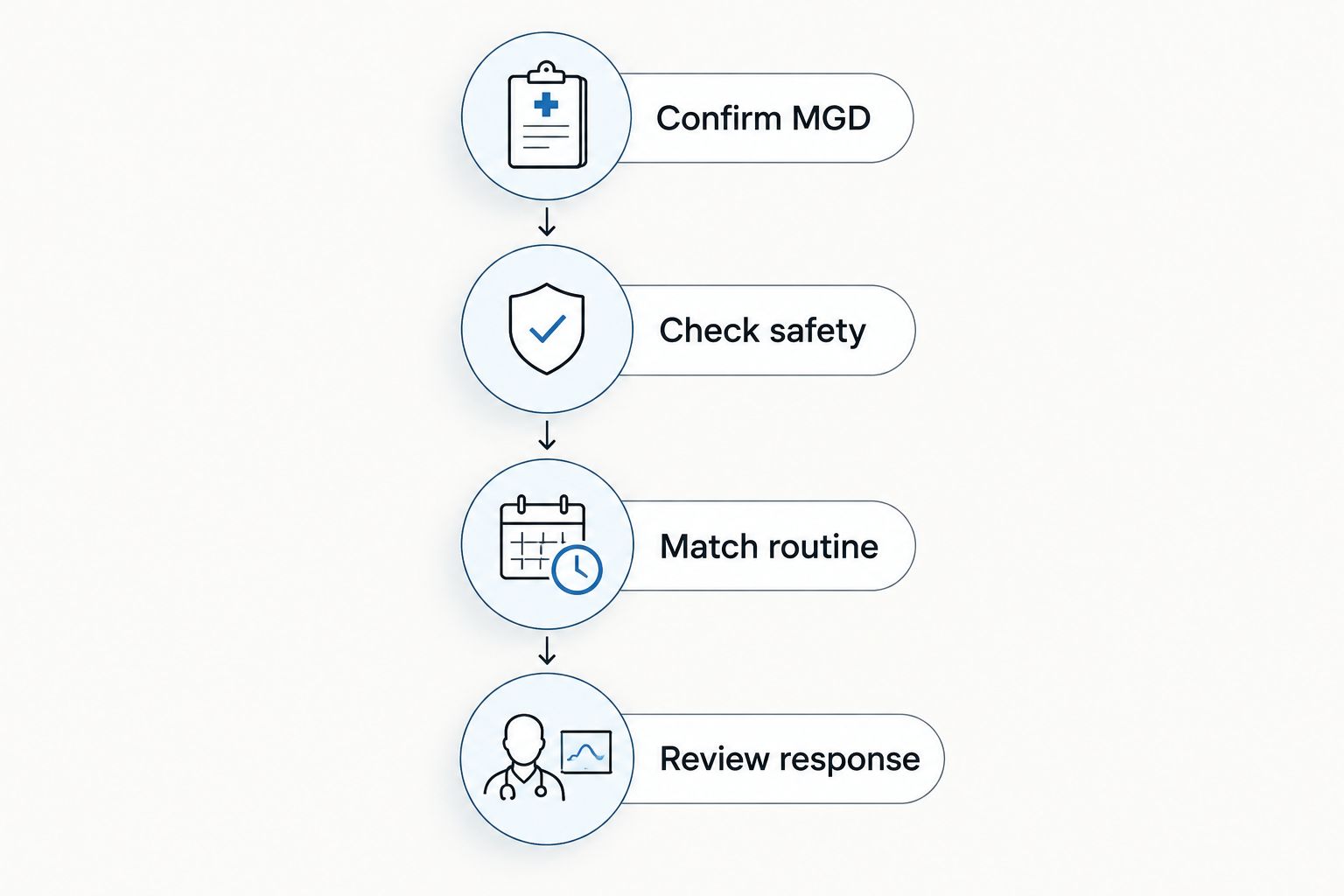
Confirm MGD
Assess symptoms alongside the eyelid margin, gland openings, meibum and ocular surface findings. Heat is relevant to obstructive MGD; the symptom label dry eye does not establish that indication by itself.
Check safety
Consider skin sensitivity, ability to recognise excessive heat and ability to remove the mask promptly. Recent surgery, an acute painful eye or other active ocular disease requires individual advice rather than a routine heat recommendation.
Match routine
Ask where the patient will use the mask, what equipment they have and which handling steps create difficulty. Choose the simplest suitable routine, not the device with the longest feature list.
Review response
Agree what will be reviewed: symptoms, technique, tolerance and clinical findings. Persistent symptoms require reassessment of the diagnosis and management plan, not automatic escalation to hotter or longer sessions.
How these formats are ranked
The ranking uses the selection criteria above: suitable heating, consistent application, patient control, hygiene and routine fit. Each recommendation owns a different use case, so the list is a decision aid rather than a claim that one format outperforms all others clinically.
The reusable microwavable format is the default for a manageable home routine. Adjustable electric devices address control needs; self-warming formats address travel; flannels support demonstration. Product-level evidence and instructions remain necessary before recommending a named device.
Which heated eye mask should you choose?
Choose a reusable microwavable eye mask first when the patient can prepare and check it safely. Choose an electric mask when verified controls address a practical need, or a self-warming format when heating equipment is inconvenient.
Before home use, cover 3 patient checkpoints: safe preparation, comfortable application and the stopping rule. Ask the patient to describe each checkpoint in their own words. A short, repeatable instruction is more useful than a complicated routine they cannot reproduce.
Scope Connect supports clinicians with dry eye resources and patient education materials. Use educational support to reinforce the agreed plan, while keeping device-specific instructions attached to the actual product.
FAQ
What’s the best heat eye mask for dry eyes?
A reusable microwavable eye mask is a practical default for patients with confirmed obstructive MGD who can prepare it safely. An adjustable electric device or self-warming format suits different handling and travel needs; no format is best for every patient.
Is an electric eye mask better than a microwavable mask?
An electric eye mask is better suited to patients who need adjustable heating, provided the selected device offers suitable controls. A microwavable mask avoids powered operation during application but requires correct preparation and temperature checking.
How long should I use a heated eye mask?
Follow the specific product instructions and the plan agreed with your eye care professional. Do not transfer a duration from another device or extend treatment because symptoms persist.
Can a heated eye mask cure meibomian gland dysfunction?
A heated eye mask does not establish a cure for MGD. Eyelid warming is a management measure, and patients need review of symptoms, technique and ocular surface findings.
Should I massage my eyelids after using a heated mask?
Use eyelid massage only when your clinician has advised an appropriate technique for your condition. Do not press firmly on the eyeball or add massage to the routine without guidance.
Can I sleep while wearing a heated eye mask?
Do not assume a heated eye mask is suitable for use during sleep. Follow its instructions and remain able to recognise discomfort and remove it promptly.
When should I stop using a heated eye mask?
Stop if the mask feels excessively hot, causes pain or worsens irritation. Sudden visual change, marked pain or a significant red eye needs prompt clinical assessment rather than continued heat treatment.
One last thing
The most useful final question is not whether the patient likes the mask. Ask them to explain how they will prepare it, apply it and decide to stop. A correct teach-back is a better basis for safe home use than an unqualified assurance that the instructions are clear.